Small Faults That Disturb Quiet Corners — Practical Fixes to Help You Settle
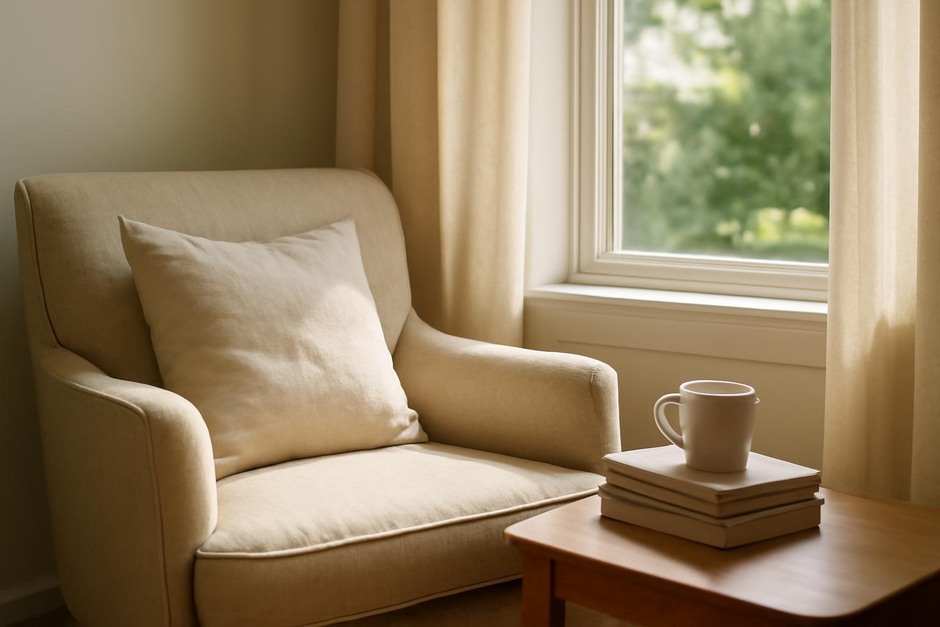
There’s a difference between a pretty corner and a corner that genuinely invites you to sit, linger, and slow down. Often it isn’t one dramatic flaw but several small, regular missteps that keep the space from feeling settled. Below is a calm checklist: brief observations of what commonly goes wrong and practical, low-effort corrections to help you test what actually improves your experience.
1. Light and Glare: Bright Isn’t the Same as Comfortable
What often goes wrong
- The main lamp is too harsh or too dim for reading, causing eye strain.
- Direct sunlight creates glare at certain times of day, making the page disappear or the screen unreadable.
- One fixed light source leaves the rest of the corner in shadow, which feels unbalanced.
Simple corrections to try
- Swap a cool-white bulb for a warm LED (2700K–3000K) to soften contrast; you can test with a single bulb first.
- Add a directional reading lamp with an adjustable arm or shade so you can aim light where you need it without flooding the whole room.
- Use a translucent curtain or a thin blind to reduce glare while preserving daylight; leave it half-closed and observe how that feels for a week.
2. Seating and Posture: The Comfortable Lie That Isn’t
What often goes wrong
- A chair looks cozy but lacks lumbar support, leaving you shifting every few minutes.
- The seat is either too high or too low to use the available surface for a book or cup comfortably.
- Heavy throws and many cushions make it hard to find a consistent position.
Simple corrections to try
- Add a small lumbar cushion or folded blanket at the lower back to support the natural curve; test different thicknesses for several evenings.
- Raise or lower the foot position with a low stool so your knees sit at a neutral angle; a short trial will reveal if you stay longer.
- Limit pillows to one or two reliable options; store extras nearby and only bring them out if you want them.
3. Surfaces and Clutter: The Accumulation That Steals Attention
What often goes wrong
- A side table becomes a catchall for mail, devices, and cups, making the space feel busy even when you’re alone.
- Books are piled in unstable stacks, which adds a sense of impermanence rather than invitation.
- Too many decorative objects compete with practical needs.
Simple corrections to try
- Adopt a one-in, one-out shelf rule for books near the chair: if you add one, remove one to another spot. Notice whether this reduces visual noise over a month.
- Keep a small tray or shallow dish on the table for essentials—glasses, a pen, a coaster—and empty it once a week.
- Choose two small, meaningful objects for the table and remove anything that isn’t actively used or enjoyed.
4. Sound and Pacing: Background Noise That Interrupts Rather Than Holds
What often goes wrong
- Inconsistent noises—distant traffic, a neighbor’s activity—break concentration and create a startle reflex.
- Constant low-volume music or a TV provides an edge of activity that stops deep reading.
- Silence can feel too complete if you’re used to a small, rhythmic background sound.
Simple corrections to try
- Introduce a gentle, predictable sound—an electric kettle’s hiss, a fan at low speed, a playlist of quiet instrumental pieces—for brief test sessions and note how it changes attention.
- Use a small fabric-covered panel or throw over a nearby hard surface to dampen echo if sudden sounds feel sharp.
- Reserve specific times for absolute quiet and other times for soft background noise, and observe which setting helps you settle more reliably.
Conclusion
Quiet corners reach their purpose through small, testable choices rather than grand redesigns. Try one correction at a time and live with it for several evenings before moving on. Often the most effective change is the least expensive: a different bulb, a folded blanket, an emptied tray, or a predictable background hum. Taken together, these modest adjustments encourage you to arrive, stay, and notice the slow pleasures that the corner was always meant to hold.